AI in the Classroom is a series highlighting the experiences of Ohio State faculty who are using AI in their teaching — what’s working, what’s still unfolding and where it’s headed next.
Beau Meyer, an associate professor in the College of Dentistry and current chair of the Dentistry Faculty Council, helped lead an AI-focused discussion during a general faculty meeting, creating a productive, candid space to move the college’s thinking on AI forward. Using structured small-group conversations, faculty shared and explored real experiences, questions and concerns about how to incorporate AI ethically and usefully in both day-to-day work and the classroom. In this Q&A, Meyer offers key takeaways other units can adapt.
What was your goal in leading an AI-focused discussion in the College of Dentistry?
Our faculty meetings have been dominated by AI topics this past academic year. During our summer 2025 faculty meeting, we used a “speed dating” format where six to eight presenters shared how they use AI for work, teaching and writing (about 60 to 80 faculty were in the room). The feedback was positive, but people wanted more time for discussion. After our fall 2025 meeting learning about the university’s AI Fluency initiative, we designed the spring 2026 faculty meeting to be structured conversations, creating space to express optimism, concerns and cautions as a group.
How did you structure the conversation, and why did you use facilitators?
I wanted a formal structure for the meeting, something that followed a scholarly approach. First, we have a qualitative research expert in our college, post-doc Erick Howard, who helped build a focus-group discussion guide and ground rules. We used AI briefly to draft initial questions based on two recent publications about dental faculty experiences using AI. Next, we fine-tuned the questions so the conversation stayed focused and productive, without it turning into a debate. Once we had the guide, I pulled a faculty roster and randomized faculty into six groups, aiming for a mix across rank and track; it wasn’t perfect, but it got us close. The idea was to put people into groups of faculty with whom they might not normally interact.
We felt it was important that each group be guided by a neutral facilitator. We recruited five facilitators who were non-dentists and non-clinical faculty, and I facilitated the sixth group. A week before the meeting, we had an orientation to the discussion guide for facilitators so they understood how to reinforce ground rules and keep discussions productive.
How did you use AI tools (like NotebookLM) during the meeting?
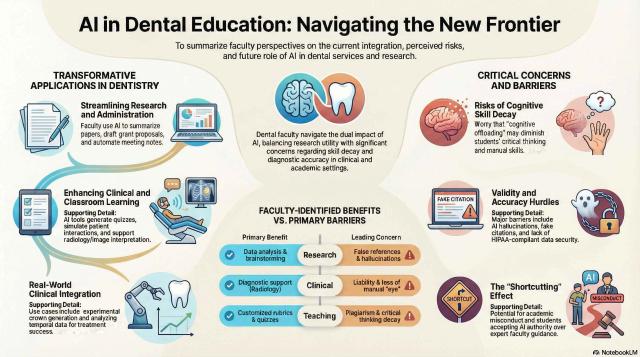
During the meeting, we used NotebookLM to take structured notes in real time across groups. That let us compare themes across the six discussions, especially during the debrief when the conversation slowed. For example, we could ask, “What were the top three concerns across groups for question 1?” and pull that directly from the notes. We also asked NotebookLM to generate an infographic aligned with the discussion questions; it was well received and served as a powerful demonstration of one way to use the technology.
What concerns and hesitations came up most often?
The most consistent concern was cognitive skill decay, or cognitive offloading: if we ask AI tools to do everything for us, will students and faculty still retain the key knowledge that distinguishes us from AI, especially in a clinical setting? AI hallucinations also came up often, meaning the tool can generate inaccurate or fabricated information, which has significant implications related to clinical questions. Those were the two concerns raised most frequently, along with the need for HIPAA-compliant platforms.
What are some practical ways dentistry faculty are using AI in teaching right now?
A small group is using AI frequently to support teaching, mainly to teach analysis rather than to generate deliverables. One common approach is to have students critique AI-generated responses. For example, a faculty member might share an AI-generated proposal (such as a suggested design for a dental appliance) and ask students, “What’s missing?” or “What hasn’t AI considered?” Faculty also use AI to refresh seminar materials for graduate students and residents, checking whether classic readings are still relevant and whether clinical guidelines have been updated. For now, the use in direct clinical care is related to patient assessment and diagnosis rather than treatment; dentistry is largely a surgical profession requiring hands-on skills, and AI doesn’t replace that part of the work.
What lessons would you share with other colleges or units planning AI conversations?
The biggest driver for success was the format and the planning that went into it up front. Creating groups at random, rather than having people sit with their usual colleagues, helped faculty connect with people they don’t interact with day-to-day and made the conversation richer. The discussion guide helped, too. We grounded it in a scholarly, qualitative approach, not because we were doing research, but because we wanted enough structure to keep the conversation collegial and open. Strong facilitators mattered. When there was robust disagreement, facilitators reoriented to the ground rules, and people who were quiet at first still found space to voice candid concerns.
What are your next steps after the conversation?
After the meeting, we distributed de-identified notes back with faculty as meeting minutes, and we used NotebookLM to write an executive summary across the six groups. Three takeaways stood out that we want to build on. First, clearer guidance on academic integrity, appropriate AI use and expectations for authorship. Second, support for faculty who feel overwhelmed by too many tools and options. Third, help in building trust and good verification habits, since AI outputs can still include inaccurate or fabricated information. We are also working on faculty development and exploring workshop ideas, including with the Drake Institute.