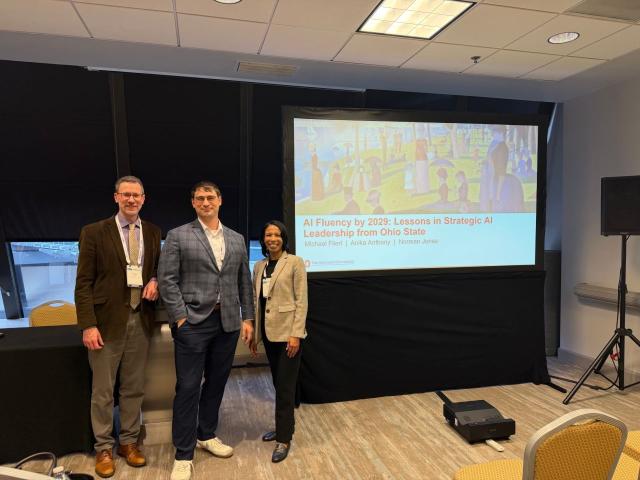
Ohio State faculty and staff had a strong presence at the 2026 American Association of Colleges and Universities Conference on AI and Higher Education in late October, sharing the work taking place at the university.
Presenters:
- Anika Anthony, Associate Vice Provost and Director, Drake Institute
- Shari Beck, Senior Instructional Designer, Drake Institute
- Molly Downing, Assistant Professor-Clinical, College of Pharmacy
- Michael Flierl, Associate Professor and AI Faculty Fellow, University Libraries
- Niki Jaburek, GE Lauch Course Coordinator, Undergraduate Education
- Sarah Henderson, Bookends Lecturer, Undergraduate Education
- Norman Jones, Vice Provost and Dean, Undergraduate Education
- Nicole Kwiek, Senior Associate Dean of Academic Affairs and Education Innovation and Professor-Clinical, College of Pharmacy
- Steven Nagel, Lead of Emerging Technology Programs, Center for Software Innovation
- Allison Schultz, Senior Instructional Designer, Drake Institute
Presentation descriptions:
Panel: Anika Anthony, Michael Flierl, Norman Jones and Steven Nagel (moderator)
Artificial intelligence has moved faster than higher education's capacity to respond. Within a few years, it has penetrated every dimension of academic work, including teaching, research, advising, operations, and assessment. What’s more, AI continues to outpace institutional planning timelines and governance processes.
The result is a reactive higher education sector, not for lack of effort but because the pace and scope of AI development left little room for deliberate institutional positioning. In that gap, AI has been defined largely on industry terms — its capabilities, applications, and appropriate use — rather than on the terms of higher education's own values and goals.
Ohio State's AI Fluency initiative is a proactive response: we emphasize building capacity to shape what AI fluency means within disciplinary contexts. Our commitment that every undergraduate will achieve AI fluency in their discipline is an assertion that higher education can seize the strategic initiative in the AI age.
This panel brings together three institutional perspectives on this commitment: Ohio State's inaugural AI Faculty Fellow, a college-level administrator, and a vice provost. Together, they examine what proactive AI strategy requires and what institutions risk by waiting.
Poster: Personal AI policies to program insights; leveraging student response to shape teaching and align strategy (Niki Jaburek and Allison Schultz)
This poster proposes reflective AI Personal Guidelines Statements as a practical way to engage students in shaping conversations about AI in higher education, giving voice to their beliefs, questions, expectations, and concerns during times of institutional change. By analyzing these reflections at the program level, educators can identify trends that inform curriculum, assessment, and policy decisions while fostering student partnership in AI-related planning.
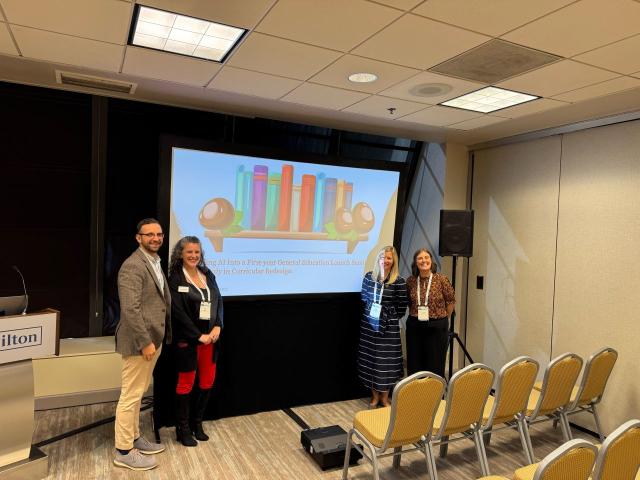
Panel: Integrating AI Into a First-year General Education Launch Seminar: A Case Study in Curricular Redesign (Sarah Henderson, Niki Jaburek and Allison Schultz)
In response to The Ohio State University’s AI Fluency Initiative, the first-year General Education Launch Seminar leveraged its large-scale, discussion-based format to engage students in reflecting on the opportunities, challenges, and ethical implications of AI without requiring technical training or specific tool use. Evidence from course implementation suggests that this invitational, values-centered approach promoted broad participation, addressed varying levels of AI expertise and comfort, and provided a scalable model for integrating institutional AI goals into first-year learning experiences.
The Drake Institute's AAC&U conference presentation focused on how Ohio State developed a support ecosystem for helping faculty and staff address the pedagogical and curricular changes necessitated by AI and the university’s AI Fluency initiative. Recognizing that instructors and academic units would have varying challenges and needs, the Drake Institute developed a range of programming and resources and partnered with multiple university offices to build a support network that could meet instructors and units where they are. The Drake's presentation encouraged participants to reflect on their own institution's needs and identify opportunities for creating similar ecosystems at their institutions.
Molly Downing, Nicole Kwiek and Steven Nagel
When AI fluency is addressed through isolated courses or individual faculty champions, students may graduate with inequitable preparation for an AI‑enabled world. Designed for faculty, academic leaders, and curriculum planners, this session presents a replicable, discipline‑grounded framework for embedding AI skill development across a curriculum.
Grounded in Backward Design principles, the framework was developed by a team of faculty, staff, and students within a college at a large R1 university. Using a two‑phase planning approach, the team moved from defining AI competencies to mapping those competencies across more than thirty courses in under five months. Central to the implementation process was the development of a modular AI literacy e‑book, piloted within the college and assessed using pre‑ and post‑measures. In summer 2025, this shared learning resource was simultaneously adapted for a university‑wide General Education launch course and re‑adapted for discipline‑specific use, enabling parallel deployment across approximately 4,000–5,000 GE students and more than thirty undergraduate, professional, and graduate courses in autumn 2025.
Anika Anthony, Shari Beck and Allison Schultz
The Drake Institute's AAC&U conference presentation focused on how Ohio State developed a support ecosystem for helping faculty and staff address the pedagogical and curricular changes necessitated by AI and the university’s AI Fluency initiative. Recognizing that instructors and academic units would have varying challenges and needs, the Drake Institute developed a range of programming and resources and partnered with multiple university offices to build a support network that could meet instructors and units where they are. The Drake's presentation encouraged participants to reflect on their own institution's needs and identify opportunities for creating similar ecosystems at their institutions.